
I got my first taste of college applications in October of 2021. I was in the process of applying to the North Carolina School of Science and Math Online Program. I wrote essays on my STEM passions, overcoming obstacles, and how COVID-19 impacted my family. And then on April 7th, 4 months after I submitted my final application, I opened my browser and texted my friends that admissions were out.
I got in.
And after scouring the course catalog, I chose my classes for the upcoming school year: Honors Computational Science and Honors Foundations of Data Science.
But before the school year started, I took Scholar Development. This was an opportunity to meet some of my future classmates and get accustomed to online classes and literary research.
My group and I were very interested in both gender studies and technology so we decided on an intersection of the two topics: How are modern societies shifting to address gender inequality in the fields of science and technology?
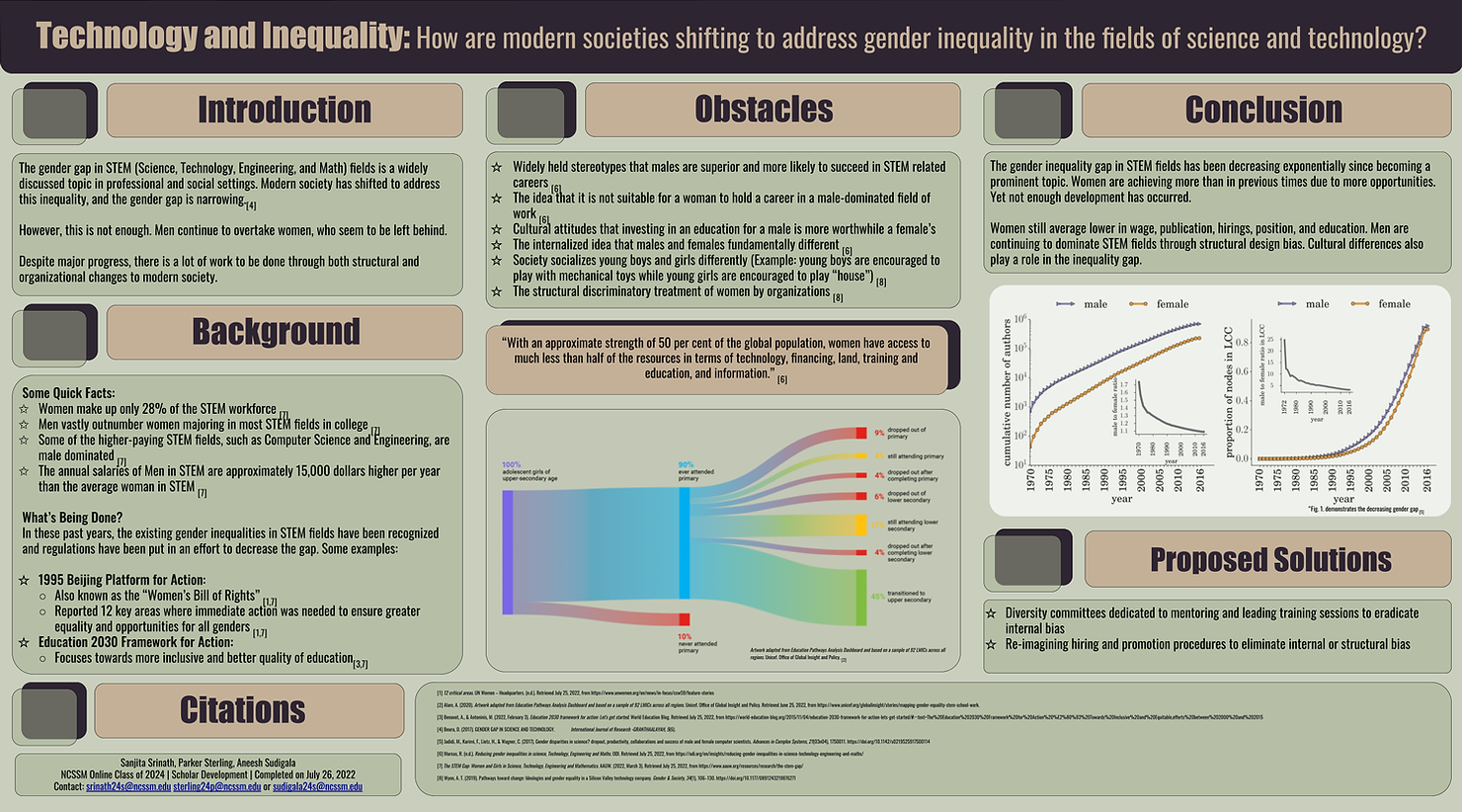
After reading through more than 15 sources, we narrowed down what we would share to a limited scope. However, I wanted to share one article that I found particularly meaningful about women in professional settings. This article was written after an extensive study of Silicon Valley tech employees.
https://journals.sagepub.com/doi/full/10.1177/0891243219876271
The article showcases inequality for women in leadership positions in a tech company and some of the information this article provides is thoroughly thought-provoking. One of the main takeaways I got from the article is their research on the different viewpoints contributing to gender inequality. Contrary to common knowledge, inequality does not singularly source from “hating women.” However as this article’s abstract states, “Executives rarely engaged in attempts to change the organization structurally. Thus, the implementation of gender equality remains limited by top executives’ ideas and assumptions about the sources of inequality.” Simply put, inequality sources from ignorance about inequality. You could call it a cycle or a loop.
In fact, take a look at this thought-provoking sentence in the section titled, “Ideologies of Inequality and Change Efforts”: “In sum, I extend existing research by examining the link between ideology and action; in doing so, I find that current diversity approaches (such as unconscious bias training and mentorship programs) derive from and reinforce harmful gender ideologies (e.g., individualistic ideologies emphasizing ingrained gender differences) that fail to challenge or change the organizational drivers of inequality, and thus maintain the status quo.”
Putting it simply: our efforts to address inequality don’t actually address inequality. And it never will unless we are aware of the viewpoints on inequality and are able to address each of them.
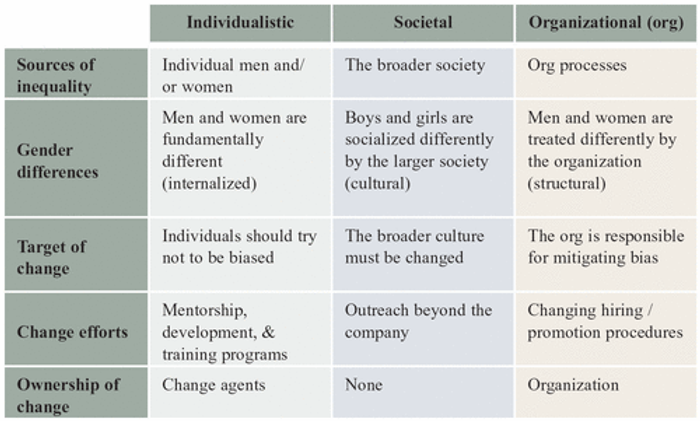
Figure one in the article puts all of the information provided in the article about viewpoints on inequality and pulls it all together in a concise table. It is not just one of these views that create inequality, it is all of them: the Individualistic, the Societal, and the Org. view. Each one requires targeting different groups to bring about change. However, as you can see from the Societal viewpoint, there is no direct point of contact to take ownership of the change. Society as a whole has to change.
After reading this article, there are a couple of points with which I disagree. I believe that the Societal view impacts both the Individualistic view and the Org. View and therefore a change in both of them cannot be fully effective unless we change society. This is where we come in, middle schoolers, high schoolers, and college students. We are the future of the country and the future of the world. Unless we combat inequality, nothing can happen.
But what can we do as a youth? It seems like a daunting task to change society but it can be done. Just speaking about these issues contributes. As we can see, it is ignorance that pushes inequality, so we need to combat that by frequently discussing it.
 SANJITA SRINATH
Leave a comment